RAG chatbot development
RAG chatbots that answer from your documents, and show you where
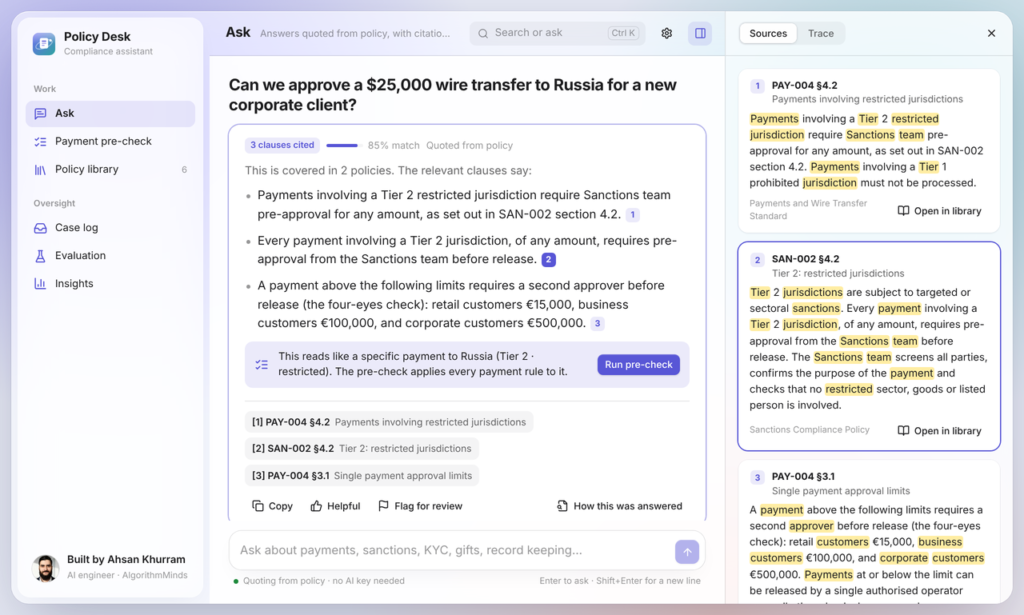
A RAG chatbot reads your own policies, manuals, contracts and tickets and answers questions from them, quoting the passage it used. I build them for websites, support teams and internal knowledge, and I build them so they don’t guess: when the answer isn’t in your documents, the chatbot says so.
Start with a $150 scoping session, credited toward the build · I reply within 24 hours on weekdays
Why most AI chatbots for websites lose people’s trust
The answers your customers and your team need are already written down. The trouble is that a general chatbot doesn’t know them, and when it doesn’t know, it improvises. It sounds confident, it quotes a policy that doesn’t exist, and someone acts on it. After that, nobody trusts it again.
Retrieval-augmented generation fixes the knowledge problem: the chatbot looks up the relevant passages in your documents before it answers. But retrieval on its own isn’t enough. A lot of the RAG chatbots I’m asked to rescue retrieve the wrong passage, answer anyway when nothing relevant comes back, and were never tested against the questions real people ask. That’s the part I focus on.
How I build a RAG chatbot you can rely on
Every answer comes with its source. The chatbot quotes the passage and links to the document, page or clause, so anyone can check it in one click. If the model ever cites something that isn’t in the retrieved text, the citation is removed before the answer is shown.
It knows when to say “I don’t know”. When your documents don’t cover a question, the chatbot says so and points to the closest sections instead of inventing an answer. For a compliance team, a support desk or a sales page, that one behavior matters more than anything else.
Retrieval is tuned to your documents. I use hybrid search, combining keyword and meaning-based matching, then rerank the results so the passages behind an answer are the ones that actually matter. Long PDFs, scanned forms and messy exports are split into sections that can be cited cleanly.
It’s tested before anyone relies on it. Before launch I build an evaluation set from the questions your team really asks, including ones the documents can’t answer, and the chatbot has to pass it. The set runs again after every change, so an update can’t quietly make answers worse.
It’s protected against misuse. Text inside a document that tries to give the AI orders is treated as plain text, requests to get around a rule are refused with the rule that forbids them, personal data can be masked, and rate limits and spending caps stop a runaway bill.
RAG chatbots that also take action: AI agents
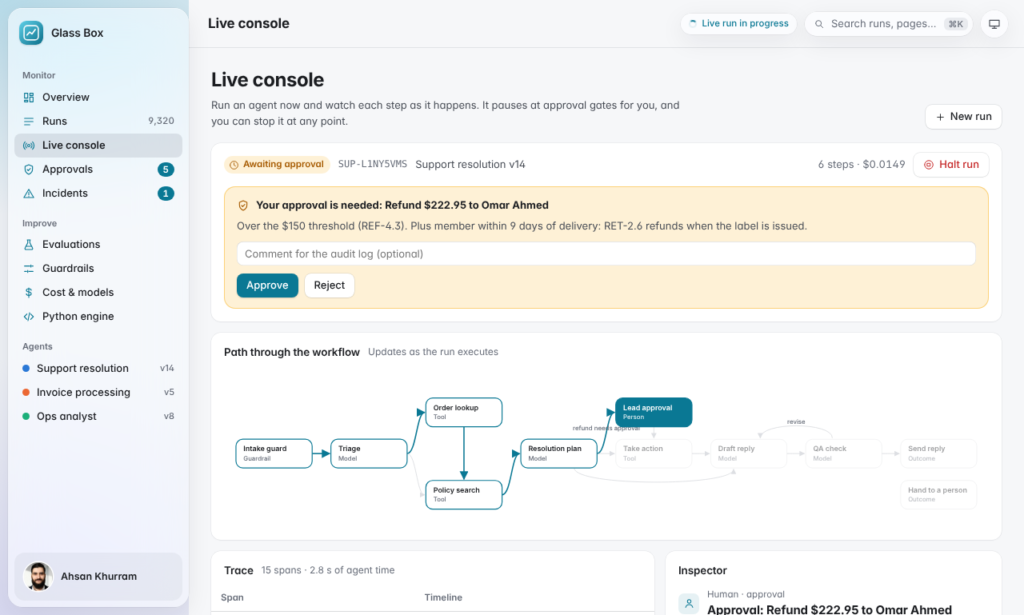
Sometimes answering isn’t enough. Where the job needs it, the chatbot becomes an AI agent that works inside your tools: it looks up a customer record, checks an invoice against its purchase order, fills a form or hands the conversation to a person. Anything risky, like a refund over a limit or a payment that doesn’t match, waits for someone on your team to approve it, and every step is logged with what it cost.
Proof: a live client chatbot and a product you can inspect
Client work
A sales chatbot that can’t invent a price
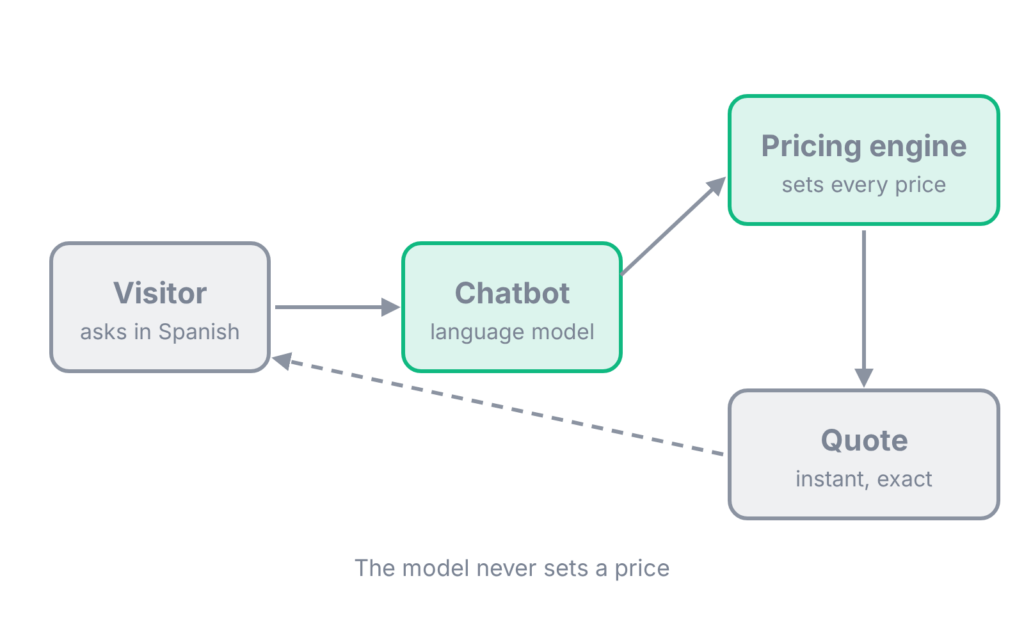
For a cabin builder in Chile, I was the sole engineer on a Spanish-language sales chatbot that gives website visitors instant quotes. The language model gathers what the visitor needs and calls a separate pricing engine, so every price comes from that engine and a quote can’t be made up or talked out of it. It has been live since September 2026, is backed by more than 800 automated tests and costs about one cent per conversation.
Self-built product
Policy Desk
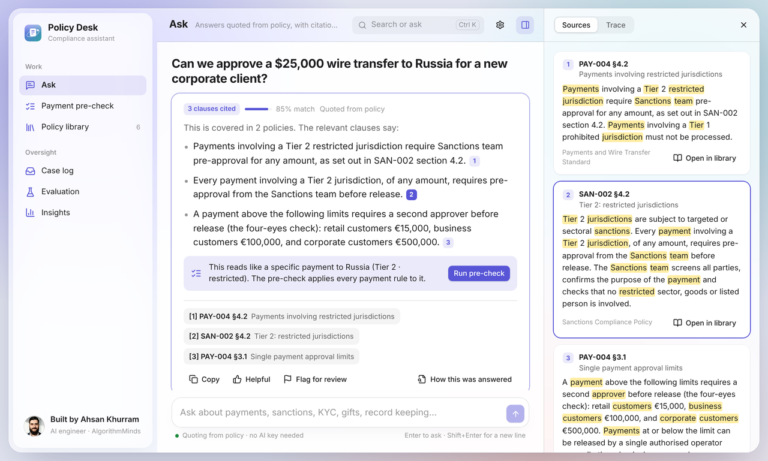
A RAG chatbot for compliance policies that quotes the exact clause behind every answer, declines questions the policies don’t cover and refuses requests to get around a control. On questions it was never tuned on, it passed 14 of 17 and found the right clause in the top three 93% of the time.
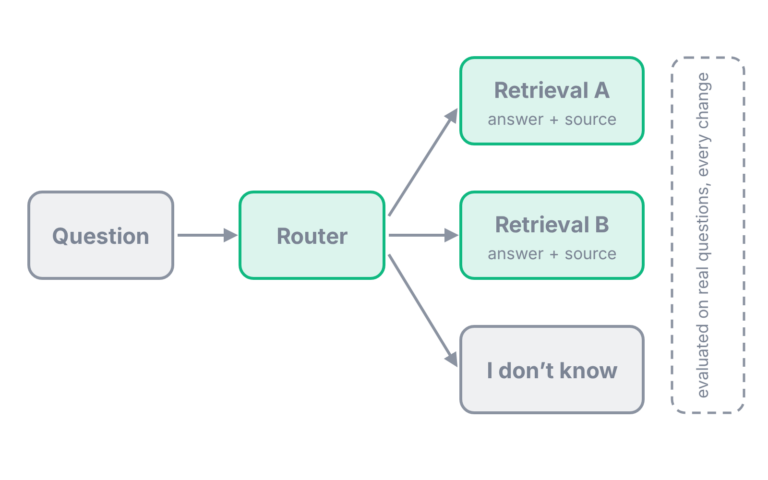
Client work
A document assistant that stopped guessing
A team’s internal assistant answered confidently even when its documents didn’t hold the answer. I rebuilt it so each question goes to the right retrieval path or to “I don’t know”, with an evaluation set rerun after every change.
Where your RAG chatbot can run
On your website, as a small chat widget that matches your brand. Inside your team’s tools, as an internal assistant over your knowledge base. Or completely private, on your own VPS or AWS account with a local model, so your documents never go to a public AI service. Model and hosting costs are billed to you directly, so you always see what it costs to run.
What a RAG chatbot project costs, and how it runs
- Scoping session, $150 A 60-minute call, then a written plan: what to build, which documents and tools, the architecture, an estimate in hours and the main risks. Paid before the call and credited toward the build.
- Fixed written quote At $80 to $100 an hour, agreed before work starts.
- Build and evaluate Paid per milestone, each before it starts. You see it working on your own questions along the way, and you can stop after any milestone.
- Handover Code in your repository, a runbook and a recorded handover call. Then 30 days of fixes, and an optional support plan from $250 a month.
Prefer marketplace protection? You can hire me for the same service at the same price on Fiverr or Upwork.
Is a custom RAG chatbot right for you?
It’s a good fit if your answers already live in documents and in a few people’s heads, if a first chatbot made things up, or if your data has to stay private. It’s usually not the right fit if there are no documents to draw answers from yet, if you’re looking for a team or an agency, or if what you need is a web or mobile app rather than the AI inside it.
RAG chatbot questions
What is a RAG chatbot?
A chatbot that retrieves the relevant passages from your own documents before it answers, and answers from those passages rather than from general knowledge. RAG stands for retrieval-augmented generation.
Can my documents stay on my own servers?
Yes. I can deploy the whole system on your VPS or cloud account, including a self-hosted model where the use case allows.
How do I know it won’t make things up?
Every answer cites its source, questions the documents can’t answer get “I don’t know”, and an evaluation set built from your team’s real questions runs before launch and after every change.
Which models do you use?
Whatever fits your budget and privacy needs: OpenAI or Anthropic models through their APIs, or an open model running on your own server. The scoping plan compares the running cost of each.
What happens to the $150 if we go ahead?
It’s credited toward the build. If you don’t go ahead, you keep the written plan.
What happens after handover?
For 30 days I fix defects in what was delivered. After that, an optional support plan starts from $250 a month.
Tell me what your chatbot should answer
A few lines is enough: the documents, who asks the questions, and where it has to run.
Start with the $150 scoping session, credited toward the build.